

 |
 |
 |
 |
 |
 |
 |
 |
 |











Introduction of multimedia codecs
|
4. Audio codecs |
|
|
4.1 G.711 PCM Audio |
||||||||||||||||||
|
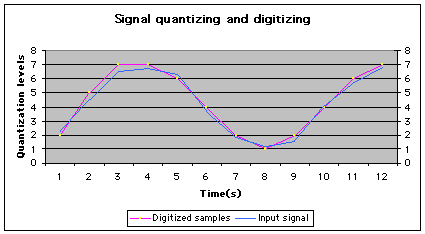
G.711 is an ITU standard for the conversion of an analogue voice signal into a stream of digital messages.[37] It is a PCM (Pulse Code Modulation) scheme operating at an 8 kHz sample rate with 8 bits per sample. Then 64kbps data bandwidth is required (8k * 8 bits = 64kbps). G.711 can encode frequencies between 0 and 4 kHz, according to the Nyquist theorem, a signal must be sampled at twice of its highest frequency component.[36] Normally G.711 is used to encode the 4kHz analogue signal that defines "toll-quality" speech. G.711 also supports the worst-case bandwidth for a single voice channel.[37] PCM coding: First, the input analogue signal is sampled like a series of pulse modulation signals (Figure 2-21). The heights of these pulses are from zero to full scale which are divided into discrete steps called quantisation levels or discrete levels. In this way, each step can be represented by a series of binary codes, as shown in Table 2-5. This coded arrangement of binary pulses is the PCM signal.[39] Figure 2-21 Quantising and digitising a signal[38] Table 2-5 Quantisation levels with belonging code words
So this PCM encoded signal in binary form is like this: 010 101 111 111 110 100 010 001 010 100 110 111 For each sample, its value is just an approximation of the original signal to the nearest discrete level. Then the reconstructed sampling signal is distorted. The difference between the original waveform and the quantised digital signal is called quantising noise. The accuracy of an approximation is primarily a matter of economics.[38] So the number of samples and the number of quantisation levels are the two main factors which influence the quality of the digitalized signal. G.711 uses 8 kHz sample rate with 8 bits per sample to create "toll-quality" digitalized speech. |



|
|
|
|
|
|
|
|
|
Designed by Yong Qiu Liu.
Copyright © 2006 All rights reserved