|
2.3 H.323 Conferencing
|
|
The H.323 standard
is another umbrella recommendation from the International Telecommunications
Union (ITU). It provides a foundation for audio, video and data
communications across IP based networks, including the Internet.
It specifies the components, protocols and procedures providing
multimedia communication over packet-based networks.
The H.323 standard
was approved in 1996 by the ITU's Study Group 16. It is a recommendation
of visual telephone systems and equipment for LANs that provide
a nonguaranteed quality of service (QoS) for multimedia communication.
In January 1998 version 2 of the standard was approved, which
addressed deficiencies in version 1 and introduced new functionality
within existing protocols as well as entirely new protocols. It
also added the functions of security, fast call setup, supplementary
service and T.120/H.323 integration.
Components
of H.323
There are four
types of components specified in the H.323 standard, terminals,
gateways, gatekeepers and multipoint control units (MCUs).
Terminals:
Terminals are the
client endpoints on the LAN that provide real-time, two-way communications
(Figure 2-36). In all terminals, voice
is supported but video and data are optional. Because the basic
service provided by an H.323 terminal is audio communications,
an H.323 terminal plays a key role in IP—telephony services.
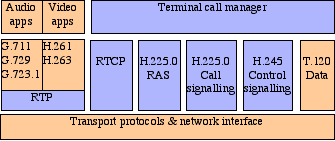
Figure 2-36 Architecture
of H.323 Terminal[57]
In Figure
2-36, there are some protocols specified by H.323.
- Audio codec: It is used
to encode the audio signals from the microphone and decode the
audio signals received to the speaker. This part is specified
in the ITU-T G711(audio at 64Kbps). There are also some additional
recommendations such as G.722 (64, 56, and 48 Kbps), G.723.1
(5.3 and 6.3 Kbps), G.728 (16 Kbps) and G.729 (8 Kbps).
- Video codec: It is used
to encode the videos from the camera and decode the videos received
from network to the display device. This is an optional pert.
It uses the recommendation of H.261 (64k~2Mbps, for low data
rates and relatively low motion as a starting point for the
development of MPEG) or H.263 (an advancement of the H.261 and
MPEG-1 standards, designed with the goal of producing substantially
better quality below 64 Kbps) See Table
2-11.
Table 2-11 ITU Formats
for videoconferencing[57]
|
Videoconferencing
Picture Format
|
Image Size (In
Pixels)
|
H.261
|
H.263
|
|
sub-QCIF
|
128x96
|
not specified
|
required
|
|
QCIF
|
176x44
|
required
|
required
|
|
CIF
|
352x288
|
optional
|
optional
|
|
4CIF
|
702x576
|
N/A
|
optional
|
|
16CIF
|
1408x1152
|
N/A
|
optional
|
- RAS: Registration, admission
and status (RAS) is used to perform registration, admission
control, bandwidth changes, status and disengage procedures
between endpoints and gatekeepers.
- H.225 Call Signalling:
The H.225 call signalling is used to establish a connection
between two H.323 endpoints by exchanging H.225 protocol messages
on the call-signalling channel.
- H.245 control signalling:
This is used to exchange end-to-end control messages governing
the operation of the H.323 endpoint, including capabilities
exchange, opening and closing of logical channels, preference
requests, flow control messages, and general commands and indications.
- RTP:
RTP (Real-time transport protocol) provides end-to-end delivery
services of real-time audio and video. Typically it is used
to transport data via UDP. RTP provides payload-type identification,
sequence numbering, time stamping, and delivery monitoring.
UDP provides multiplexing and checksum services.
- RTCP:
Real-time transport control protocol (RTCP) is the counterpart
of RTP that provides control services. It provides feedback
on the quality of the data distribution and carries a transport-level
identifier for an RTP source.
Gateways:
Gateways provide
a translation function between H.323 conferencing endpoints and
other terminal types which includes translation between transmission
formats (i.e. H.225.0 to H.221), between communications procedures
(i.e. H.245 to H.242) and even between audio and video codecs.
It also performs call setup and clearing on both the LAN side
and the switched-circuit network side. But it is an optional element
between two terminals on an H.323 conference.
Gatekeepers:
A Gatekeeper is
the most important component of an H.323 enabled network. It is
the focal point for all calls within the H.323 network. Gatekeepers
perform two important call control functions. The first is address
translation from LAN aliases for terminals and gateways to IP
or IPX addresses, as defined in the RAS specification. The second
function is bandwidth management, which is also designated within
RAS.
Gatekeepers also
provide other important services, although they are not mandatory,
such as authorisation and authentication terminals and gateways,
accounting, billing and call-routing services. In many ways, it
acts as a virtual switch.
The functions of
the Gatekeeper are shown in Table 2-12
and Table 2-13.
Table 2-12: Gatekeeper
Functions[57]
|
Address
Translation
|
Translation of alias address
to Transport Address using a table that is updated with Registration
messages. Other methods of
updating the translation table
are also allowed.
|
|
Admissions Control
|
Authorisation of LAN access
using Admission Request, Confirm and Reject (ARQ/ARC/ARJ)
messages. LAN access may be based on call authorisation, bandwidth,
or some other criteria. Admissions Control may also be a null
function, which admits all requests.
|
|
Bandwidth Control
|
Support for Bandwidth Request,
Confirm and Reject (BRQ/BCF/BRJ) messages. This may be based
on bandwidth management. Bandwidth Control may also be a null
function which accepts all requests for bandwidth changes.
|
|
Zone Management
|
The Gatekeeper provides the
above functions for terminals, MCUs, and Gateways which have
registered within its Zone of control.
|
Table 2-13: Optional
Gatekeeper Functions[57]
|
Call
Control Signalling
|
In a point to point conference,
the Gatekeeper may Gatekeeper may send the endpoints G.931
signals directly to each other.
|
|
Call Authorisation
|
The Gatekeeper may reject a
call from a terminal based on the Q.931 specification. The
reasons for rejection may include, but are not limited to,
restricted access to/from
particular terminals or Gateways,
restricted access during certain periods of time. The criteria
for determining if authorisation passes or fails is outside
the scope of H.323.
|
|
Bandwidth Management
|
The Gatekeeper may reject calls
from a terminal if it determines that sufficient bandwidth
is not available. This function also operates during an active
call if a terminal requests additional bandwidth. The criteria
for determining if bandwidth is available is outside the scope
of H.323.
|
|
Call Management
|
The Gatekeeper may maintain
a list of ongoing H.323 calls in order to indicate that a
called terminal is busy or to provide information for the
Bandwidth Management function.
|
MCU:
The Multipoint
Control Unit (MCU) supports conferences between three or more
endpoints. An MCU consists of a Multipoint Controller (MC) and
Multipoint Processors (MP, this is optional).
The MC handles
H.245 negotiations between all terminals to determine common capabilities
for audio and video processing and controls conference resources
by determining which of the audio and video streams will be multicast.
Whereas the MP
does the audio mixing, data distribution and video switching/
mixing functions typically performed in multipoint conferences
and sends the resulting streams back to the participating terminals.
It also provides conversion between different codecs and bit rates
and may use multicast to distribute processed video.
Features of the
H.323 standard
- Codec Standards of audio and
video data streams.
- Interoperability and without
worrying about compatibility between users.
- Network Independence because
it is designed to run on top of common network architectures.
- Platform and Application Independence
- Multipoint Support by using
MCU (although H.323 can support conferences of three or more
endpoints without requiring a specialised multipoint control
unit).
- Bandwidth Management by limiting
the number of simultaneous H.323 connections within their network
or the amount of bandwidth available to H.323 applications.
- Multicast transmission makes
the use of bandwidth more efficiently
- Flexibility of including endpoints
with different capabilities (audio, video…).
- Inter-Network Conferencin
|
|
|