

 |
 |
 |
 |
 |
 |
 |
 |
 |











Networking service systems and related standards
|
3.3 TCP/IP and UDP |
|||||||||||||||||||||||||||||||||||||||||||||||||||||||||
|
TCP/IP is a set of protocols that is developed to allow computers to share resources across a network. It provides "low-level" functions for many applications for doing specific tasks, like transferring files between computers, sending mail, or connecting to people on another computer. Here are the most important TCP/IP services:
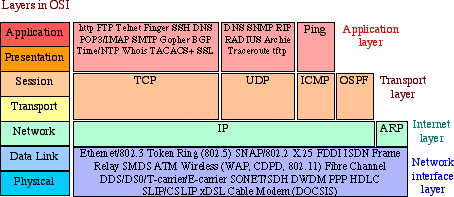
The TCP/IP protocol
architecture is shown in Figure A-4.
It shows the major protocol and application components common
to most commercial TCP/IP software packages and their relationship.
TCP/IP protocols are designed to operate over nearly any underlying local or wide area network. IP messages can be transported over all of the technologies, although certain accommodations may need to be made. The Serial Line Internet Protocol (SLIP) and Point-to-Point Protocol (PPP) are two underlying network interface protocols particularly relevant to TCP/IP. They can provide data link layer protocol services independently and enable a remote computer to attach directly to a host server and connect to the Internet using IP. Following is a brief description of the operations of PPP:
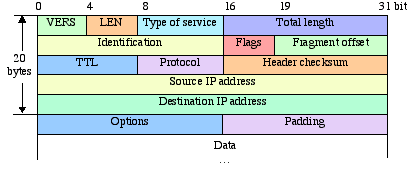
This layer is equivalent to the OSI Network Layer. IP provides a connectionless datagram transport service over the network. As at this layer the network does not guarantee delivery nor notify about packets lost, this service is called an unreliable service. IP datagrams can contain data up to 65,535 bytes but do not provide a mechanism for flow control. IP header: The basic IP packet header format is shown in Figure A-5. Each row represents a single 32-bit word and an IP header will be at least 5 words (20 bytes) in length. The description of the IP header is in Table A-3. Figure A-5 IP hearer[93]
IP Addresses: IP addresses are typically written as a sequence of four numbers that separated by periods, totally 32 bits in length. A sample IP address is 130.123.96.91. Figure A-6 IP address format For routing purposes IP addresses are subdivided into two subfields, the Network Identifier (NET_ID) that identifies the TCP/IP subnetwork to perform high-level routing between networks and the Host Identifier (HOST_ID) that indicates the specific host within a subnetwork. IP defines several address classes to address different size networks (Figure A-6).
Classes A, B, and C are used for host addressing and the only difference between the classes is the length of the NET_ID subfield. Whereas Class D and Class E are used just for special purpose only. The subnet mask: The subnet mask can be used to subdivide a large address space into subnetworks or to combine many small address spaces. To determine the subnet portion of the address, we simply perform a bit-by-bit logical AND of the IP address and the mask. For example, a Class B address space 130.123.0.0 could segment this into a 16-bit NET_ID, 4-bit SUBNET_ID, and 12-bit HOST_ID. In this case, the subnet mask for Internet routing (16-bit NET_ID ) would be 255.255.0.0 (11111111, 11111111, 00000000, 00000000 in binary), while the mask for routing to individual subnets within the larger Class B address space (16-bit NET_ID + 4-bit SUBNET_ID ) would be 255.255.240 (11111111, 11111111, 11110000, 00000000 in binary). The use of class-based addresses in IP causes IP address exhaustion. This has been a concern since the early 1990s. To make fully use of these IP address spaces, several mechanisms are used.
The Domain Name System (DNS): For convenience, most IP hosts have both a numeric IP address and a unique name. But for routing purposes, the name must be translated back to a numeric address. The DNS is a database that contains host name and IP address information for all domains on the Internet. There is a single authoritative name server for every domain that contains all DNS-related information about the domain. To obtain a host's IP address from the host's name, a DNS request is made by the initial host to a local name server. If the local name server configured or cached this IP address, it responds to the request with information, otherwise, the local name server forwards the request to one of the root servers. The root server, then, will determine an appropriate name server for the target host and the DNS request will be forwarded to the domain's name server. IP Routing: The IP has the responsibility to route packets over network. It looks up the destination IP NET_ID of a packet in a routing table and forwards it following the information in the table. There are three routing protocols commonly associated with IP and the Internet, RIP, OSPF and BGP. The Routing Information Protocol (RIP-2) specifies the way routers exchange routing table information using a distance-vector algorithm. Neighbouring routers exchange their entire routing tables periodically by RIP. Current routing protocols for many of today's LANs are based upon RIP. The Open Shortest Path First (OSPF) is a more robust protocol that is rapidly replacing RIP in the Internet. As a link state routing algorithm, it converges faster, requires less network bandwidth and is better able to scale to larger networks. A router broadcasts only changes in the status of its links rather than the entire routing tables. The Border Gateway Protocol version 4 (BGP-4): As an exterior gateway protocol, it provides routing information between Internet routing domains. Similar to RIP, BGP is a distance vector protocol but it stores the actual route to the destination network. It also allows a network's administrator to create routing policies based on political, security, legal, or economic issues rather than technical ones.
This layer is equivalent to the OSI Transport and Session Layers. There are two important protocols in this layer, Transmission Control Protocol(TCP) and the User Datagram Protocol (UDP) (Figure A-4). Here are the concepts used in this layer: Port: A port is a 16-bit number that is used to address the higher-level protocol or application program to deliver incoming messages. Each process that wants to communicate with another process has one or more ports to identifie itself to the TCP/IP protocol suite. Port numbers have different ranges:
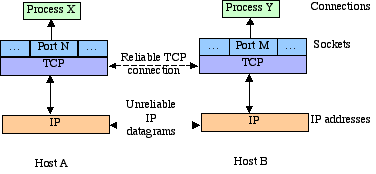
Sockets: A socket is a special type of file handle, which is used by a process to request network services from the operating system. A socket address is the triple: {protocol, local-address, local-process}. For example, {tcp, 193.44.234.3, 12345} is the TCP/IP suite socket. [93] As shown in Figure A-7, there are two processes for communicating via TCP sockets. Each side of a TCP connection has a socket identified by the pair { IP address, port number }. The two processes communicating over TCP form a logical connection identifiable by the combination { local IP address, local port, remote IP address, remote port}. Figure A-7 Two processes communicating via TCP sockets TCP: TCP provides a connection oriented, reliable, byte stream service. The two applications using TCP must establish a TCP connection with each other before they can exchange data. It is a full duplex protocol that each TCP connection supports a pair of byte streams flowing in each direction. There is a flow-control mechanism that enables the receiver to limit the amount of data the sender can transmit. It also implements a congestion-control mechanism.[91] TCP provides the following functions[91]:
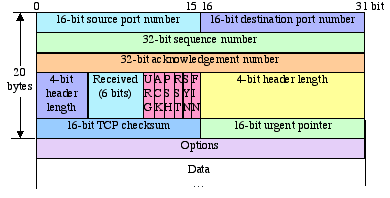
TCP header: TCP data is encapsulated in an IP data-gram. Figure A-8 shows the structure of the TCP header. Its normal size is 20 bytes unless options are present. Figure A-8 TCP header The Acknowledgement number field contains the next sequence number that the receiver expects to receive. The 6-bit Flags field is used to relay control information between TCP peers. The possible flags include SYN, FIN, RESET, PUSH, URG, and ACK.
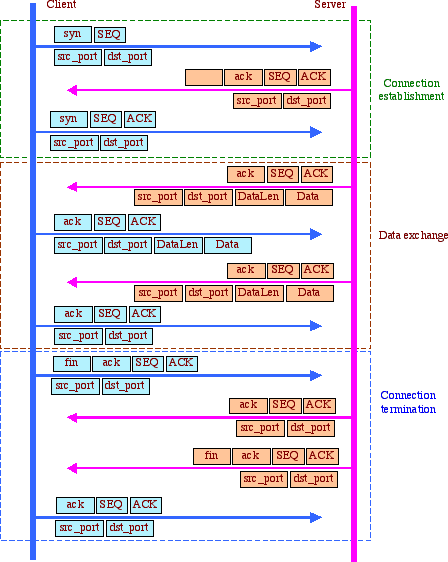
The Option field is the maximum segment size the sender wants to receive, which was specified by each end of the connection on the first segment exchanged. The data portion is optional. TCP Logical Connections: TCP connections have three main parts: connection establishment, data exchange, and connection termination (Figure A-9). Figure A-9. TCP logical connection phases Table 40 lists the descriptions of the messages used in Figure A-9 Table A-4 The descriptions of the messages used in Figure A-9
This is a normal scenario for setting up a TCP connection between a client and server. UDP (User Datagram Protocol): UDP is designed for applications where it is not necessary to put sequences of datagrams together. As for TCP, there is a UDP header (Figure A-10). It puts the UDP header in front of the data and then sends the data to IP. UDP does not split data into multiple datagrams. Neither does it keep track of what it has sent so it does not care if data is lost. The UDP header is shorter than a TCP header. It still has source and destination port numbers, and a checksum, but no other features. UDP is used by the protocols that handle name lookups and a number of similar protocols. [92] Two UDP hosts communicate in a similar fashion; one host sends a UDP datagram to the other which is presumably listening on the port indicated in the datagram. This is what happens in special conditions:
The TCP/IP Application Layer protocols support the applications and utilities that perform over the network. This is where the user interacts with the network. All network applications include http clients, ftp, telnet, mail and news are at the application layer. They use either TCP or UDP to communicate with other machines. Our application also located on this layer. |
|||||||||||||||||||||||||||||||||||||||||||||||||||||||||




|
|
|
|
|
|
|
|
|
Designed by Yong Qiu Liu.
Copyright © 2006 All rights reserved