

 |
 |
 |
 |
 |
 |
 |
 |
 |











Introduction of multimedia codecs
|
4.3 G.722 SB-ADPCM Audio |
|
G.722 is an audio codec recommendation of ITU that supports 50 to 7kHz audio bandwidth at 64 Kbps. The coding system is SB-ADPCM (sub-band adaptive differential pulse code modulation). G.722 is designed for high quality voice communications and can be used in a variety of applications, including audio coding for medium quality audio systems. [42] G.722 is a widely used standard by news organisations throughout the world. It supplies narrow bandwidth audio either up to 7.5k in mono over a single 64 kb/s B channel or up to 15k in mono over two B channels. [40] G.722 supports 16kHz sample rate to capture audio frequencies between 50 and 7kHz. The two ADPCM sub bands used by this standard give audio performance superior to a single band ADPCM algorithm operating at the same bit rate. [43] The original signal is digitised by using a 16-bit A-D converter sampled at 16 kHz. The output from the encoder is 8 bits at an 8 kHz sample rate for a 64 Kbps B channel. The decoder operates in exactly the opposite fashion. The overall compression ratio of the G.722 audio coder is 4 to 1. [40]
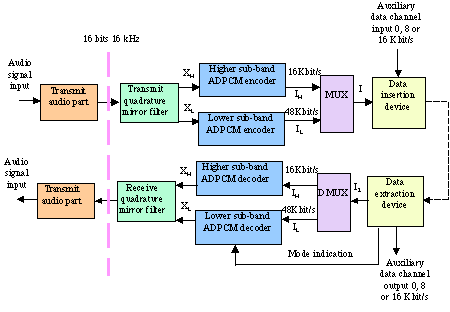
Transmit audio part: First the input signal is sampled and quantised into digital signal with 14 bits and 16 kHz sampling. (Figure 2-24) Transmit QMF (Quadrature Mirror Filter): Then the digitised signal is divided into two critically sub-sampled (8 kHz sampled) components, low sub-band and high sub-band. This sub-band splitter is based on two identical finite impulse response quadrature mirror (bandpass) filters (QMF). There are overlap and aliasing between the two sub-bands. But these will be cancelled in the synthesis QMF filter bank at the receiver. However, the quantisation error on the two sub-bands will not be eliminated. Therefore, 24-tap QMF filters with a stop-band attenuation of 60 dB are employed. [44] ( (Figure 2-24). [44] SB-ADPCM encoder: After the frequency band is split into two sub-bands (higher and lower), the signals in each sub-band are encoded using ADPCM. This is called SB-ADPCM technique. There are three basic modes of operation in the encoding system corresponding to the bit rates used for 7 kHz audio coding: 64, 56 and 48 Kbps. In the latter two modes, an auxiliary data channel of 8 and 16 Kbps is allowed respectively within the 64 Kbps by making use of bits from the lower sub-band (Figure 2-24).[41] Multiplexing: Then the two encoded sub-bands are multiplexed into one 64 Kbps channel which includes the auxiliary data channel if it has(Figure 2-24). Data insertion device: If necessary, an auxiliary data channel of 8 or 16 Kbps can be inserted into the multiplexed signal by adding 1 or 2 audio bits per octet respectively. Then the 64kb/s encoded output signal is ready for use (Figure 2-24). The decoding procedure operates in the opposite fashion (Figure 2-24).
Figure 2-24 Block Diagram of G.722 Audio Coder[44] |



|
|
|
|
|
|
|
|
|
Designed by Yong Qiu Liu.
Copyright © 2006 All rights reserved